The Mystery of "Hop" vs. "Hope"
When young learners first discover CVC (Consonant-Vowel-Consonant) words, they learn that a vowel stuck between consonants makes its short sound. For example, the "o" in hop says /ŏ/.
But what happens when you add an "e" to the end to make hope? Suddenly, the "o" changes its sound completely to say its own name: /ō/. Why? How can an "e" that makes no sound at all completely change the word?
Meet the Magician: Silent E
The "E" at the end of the word is known as the Silent E (or Magic E, Sneaky E, Bossy E). It lives up to its name because it is completely silent—you don't hear it at all.
Instead of making a sound, the Silent E acts like a magician. It stands at the end of the word and sends its "magic power" back over the consonant to the vowel before it. This power allows the vowel to "say its own name" (make its long sound).
The Rule: The "e" is silent, and the first vowel is LONG.
Watch the Magic Happen: Short vs. Long Vowels
The best way to teach the Silent E rule is to show how adding an E changes a closed syllable (short vowel) to a VCe syllable (long vowel).
| Short Vowel (CVC) | Add Magic E | Long Vowel (VCe) |
|---|---|---|
| hop (/ŏ/) | + e | hope (/ō/) |
| mat (/ă/) | + e | mate (/ā/) |
| cut (/ŭ/) | + e | cute (/ū/) |
| bit (/ĭ/) | + e | bite (/ī/) |
| pin (/ĭ/) | + e | pine (/ī/) |
How to Visualize the Magic with WordChop
Telling children that the "E" throws magic over the consonant can be confusing until they see it. This is where a digital tool like WordChop is invaluable in the classroom or at home.
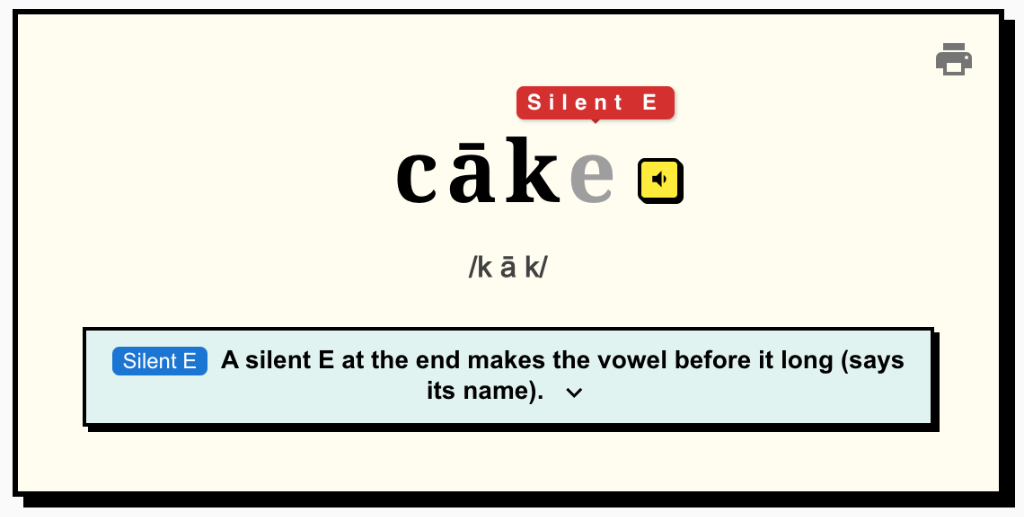
WordChop visually isolating the Silent E and explaining the rule
When you type a word like hope or cute into WordChop:
- It automatically identifies the VCe block as a single phonetic unit.
- It visually mutes the "e" so students instantly know they shouldn't pronounce it (no more saying "hop-ee"!).
- It highlights the long vowel to show that the E's magic worked.
Try it out right now! Click any of the Magic E words below to see them instantly chopped and visualized in the WordChop app.
You can encourage students to type in their "Short vs. Long" pairs (like cap vs. cape) into WordChop and watch how the AI automatically adjusts the pronunciation symbols in real-time. Hearing the difference while seeing the visual blocks helps lock the rule firmly in their memory.
Silent E's Many Jobs
While making vowels long is the Magic E's most famous job, it actually wears several other hats in the English language!
Here are just a few other things Silent E does:
- Softens C and G: It changes the hard /k/ sound of C to a soft /s/ (dance), and the hard /g/ sound of G to a soft /j/ (large).
- Stops words from ending in V: English words rarely end in V, so E acts as a placeholder (have, love, give). Wait—did you notice that the "a" in "have" is short despite the E? That's because the E is too busy doing its "no words end in V" job!
- Keeps singular words from looking plural: We add an E to words like house and please so they don't look like plural words (hous/pleas).
Teaching Tips to the Rescue
Watch out for the "Uh" trap
A common mistake early readers make is trying to sound out the E by giving it a schwa (/uh/ or /ee/) sound. They might try to read make as "may-kuh". Remind them firmly: The E is COMPLETELY silent. It's a magician, and magicians don't talk while performing their tricks!
The "Silent Wand" Activity
Give students a literal magic wand (a pencil with a star attached). Have them point the wand at the E, trace an arc over the consonant to the vowel, and loudly say the vowel's name.
Mastering the Silent E opens the door to hundreds of new words for early readers. Practice with WordChop to make the learning process undeniably magical!